
cyber-security
01.10.2026 · Ihor Frolikov
cyber-security
Fraud Prevention in Online Shops: Detecting Suspicious Orders Before Damage Occurs
A technically secure shop does not protect against economic damage from fraud. Why Fraud Risk Scoring combines individual suspicious characteristics instead of blocking indiscriminately — and why rules must fit the specific shop.
Online shops invest heavily in security: updates, firewalls, secure payment providers, monitoring and access protection.
However, a risk often only arises after an order has successfully been placed in the shop.
Stolen payment data, false addresses, unusual order patterns or deliberately abused customer accounts can lead to payment defaults, chargebacks and additional administrative effort.
The challenge is not simply to block as many orders as possible.
Good fraud prevention must avoid two mistakes: accepting risky orders — and at the same time wrongly rejecting legitimate customers.
Why Individual Characteristics Say Little
A different delivery address is not automatically suspicious.
Perhaps a customer is ordering a gift.
An unusually large order is likewise no proof of fraud.
Perhaps it's a business customer.
An IP address from a different country can also be completely legitimate.
It only becomes interesting, therefore, once several factors are considered together.
For example:
- the billing and delivery address differ significantly,
- the order is unusually large,
- the customer account was only just created,
- there is no previous order history,
- the IP location and delivery address are far apart,
- certain contact details seem implausible,
- several conspicuous order attempts occur in quick succession.
Only the combination of such signals enables a more meaningful risk assessment.
Risk Scoring Instead of Blanket Blocks
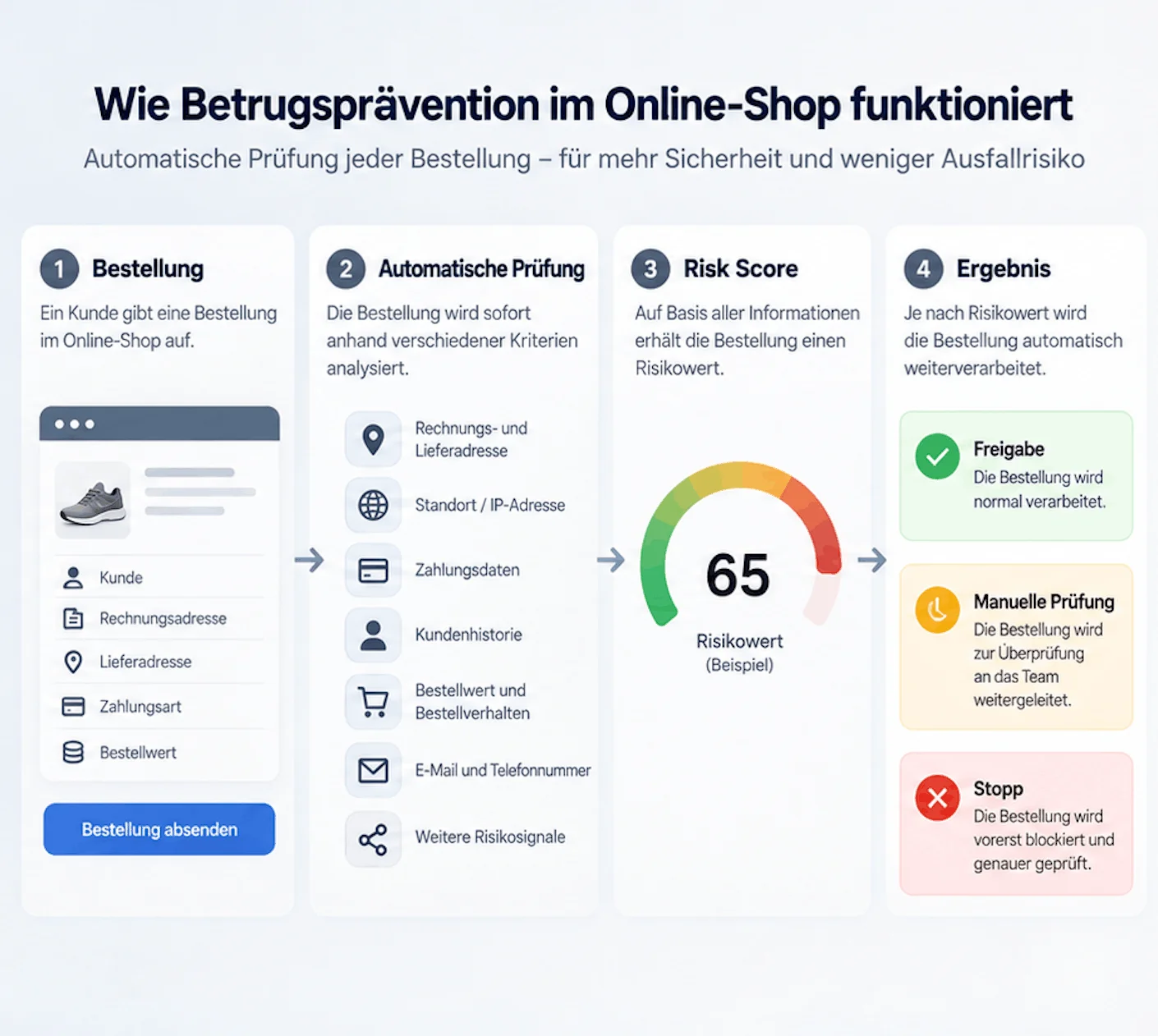
One option is automated Fraud Risk Scoring.
In this approach, an order receives a risk value based on defined criteria.
A shop can then distinguish between, for example, three groups:
Low risk — the order is processed normally.
Unclear risk — the order is flagged for manual review.
High risk — the order is stopped for now and examined more closely.
The decisive advantage is that staff do not have to manually check every order.
Their attention is concentrated on the cases where several risk signals actually occur.
Which Data Can Be Taken Into Account?
Depending on the shop and business model, different factors can be relevant.
These include, for example, order value, customer history, IP history, geographic discrepancies as well as billing and delivery information.
The typical structure of a shop's orders also plays a role.
If, for example, the average shopping cart is between 100 and 500 euros and a new customer suddenly orders goods worth several thousand euros, that does not automatically mean fraud.
But it can be a good reason to examine the order more closely.
Rules Must Fit the Shop
An important point is often underestimated in fraud prevention: there is no universal rule that works for every online shop.
A B2B shop with large shopping carts needs different criteria than a B2C shop with products for 20 euros.
A retailer with international shipping must assess geographic discrepancies differently than a shop that only delivers within Germany.
Existing customers should also be able to be treated differently than completely new accounts.
That's why a fraud prevention system should be individually adapted to the business model.
Automation Does Not Replace Every Decision
Automated risk assessment is not meant to remove staff entirely from the decision-making process.
On the contrary: it is meant to help them recognise more quickly which orders actually need attention.
A conspicuous order can be flagged automatically. A staff member then decides, based on the available information, whether the order is approved, put on hold or cancelled.
This turns a manual check of all orders into a targeted review process.
Chargebacks Are Not the Only Problem
Fraudulent orders don't just cause the actual loss of goods.
Additionally, the following can arise:
- chargeback fees,
- shipping and return costs,
- internal review effort,
- support costs,
- problems with payment service providers,
- time spent on documentation and clarification.
At the same time, a wrongly rejected order also costs money.
A genuine customer whose order is cancelled without a comprehensible reason may order from a different retailer next time.
That's why fraud prevention should work not as aggressively as possible, but as precisely as possible.
Fraud Prevention as Part of Shop Security
Cybersecurity in e-commerce doesn't end at the server.
A technically secured Magento shop can still suffer economic damage if fraudulent orders or conspicuous transactions are not detected.
Modern shop security should therefore consider several layers: technical security, secure payment processes, continuous monitoring and the automated analysis of conspicuous orders.
Especially for shops with higher order volumes or high-priced products, rule-based risk scoring can help make risks visible earlier while also reducing the manual effort in day-to-day operations.
The decisive question, therefore, is not only: "Is our shop technically secure?"
But also: "Do we recognise in time when a technically valid order is economically suspicious?"
Detect Suspicious Orders Automatically
You don't want to manually review every order, but you do want to catch suspicious orders early?
With our Magento Fraud Prevention Check & Setup, we review your shop, install the technical solution and configure the first risk-score rules to fit your business model.
€499 plus VAT — Set Up Magento Fraud Prevention